
Corporate Services · Miami, FL
Form Your Business in Miami the Right Way
Choosing the wrong entity structure can follow you for years — in taxes, in liability, and in how hard it is to grow. PAGIO's walks you through every decision and handles the paperwork from start to finish.
30+
Years of combined
experience
1,500+
Small businesses
served
4.8★
Google Reviews
from clients

Why This Decision Matters
The Structure You Choose Shapes Everything That Follows
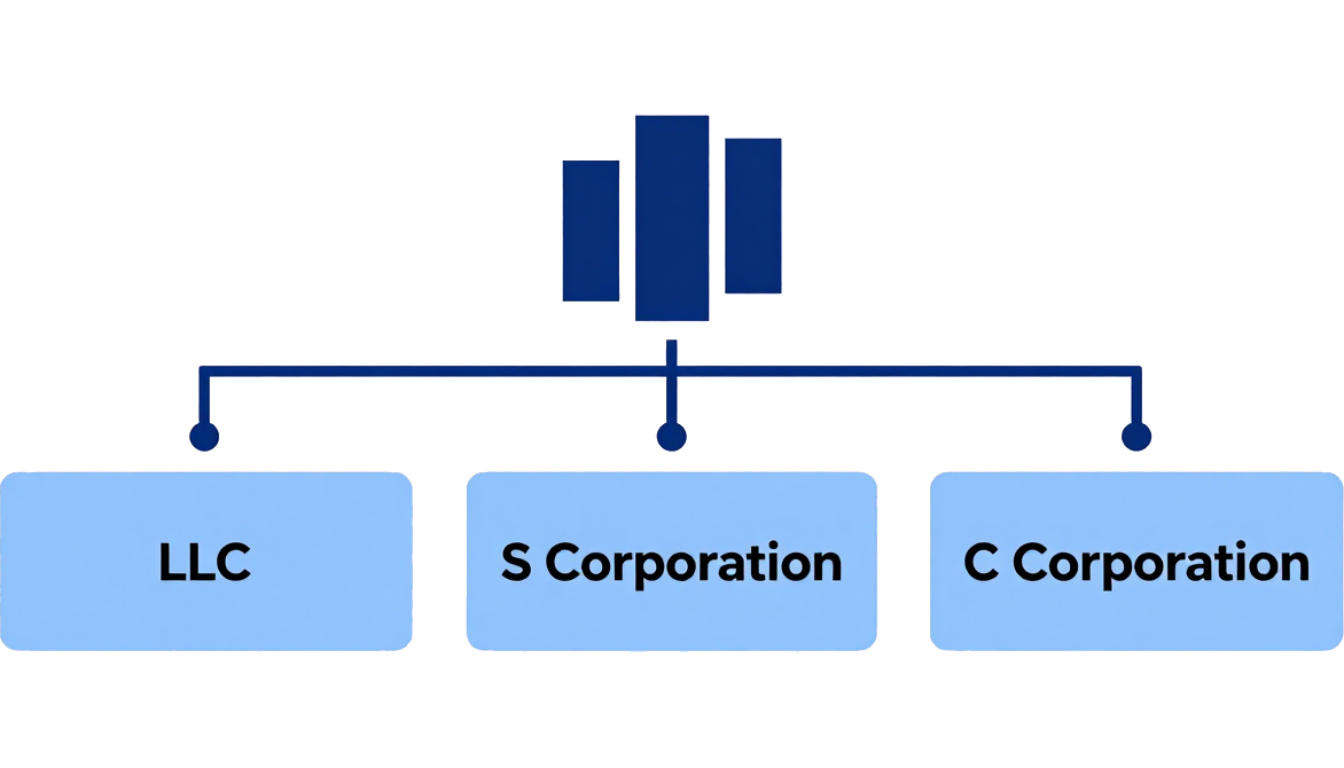
The structure you register under isn't just administrative. It determines how you're taxed, what happens if someone sues you, and how difficult it becomes to bring on partners or outside investment. Getting this right at the start is far easier — and less expensive — than restructuring later.
Florida has its own registration requirements, annual report deadlines, and compliance rules that generic guides often get wrong.
Miami's business environment is also genuinely international — many PAGIO's clients have cross-border ties, and the right entity structure for a domestic business isn't always the right fit for one with foreign principals or international clients.
Choosing Your Entity
The Main Structures and What Each One Means
There's no single "best" entity. The right choice depends on how you plan to run the business, how many owners are involved, how you want to handle taxes, and what kind of liability protection you need.
Most Common for Small Business
Limited Liability Company (LLC)
An LLC is often the starting point for small business owners because it separates personal assets from business liabilities without creating the administrative burden of a corporation. In Florida, LLCs are flexible — you can be taxed as a sole proprietor, a partnership, or elect to be taxed as an S-Corp if it makes sense for your situation.
A good fit for: solo operators, small service businesses, real estate investors, and partnerships where simplicity matters.
Popular Tax Savings Structure
S Corporation
An S-Corp is actually a tax election, not a separate entity type — you form a corporation (or sometimes an LLC) and then elect S-Corp status with the IRS. The main benefit is that business owners can pay themselves a reasonable salary and take additional profits as distributions, potentially reducing self-employment tax exposure. There are restrictions on ownership and shareholder counts.
A good fit for: established businesses with consistent profits where the tax savings exceed the added administrative cost.
Most Common for Small Business
C Corporation
A C-Corp is a fully separate legal entity subject to corporate income tax. It's the structure required if you're planning to raise outside investment, bring on a large number of shareholders, or eventually pursue an IPO. C-Corps also offer the most flexibility for benefits and compensation, though the double-taxation issue — tax at the corporate level, then again when dividends are paid — needs to be planned around carefully.
A good fit for: businesses planning to raise venture capital, international businesses, or founders with long-term exit strategies.
Everything Included
Corporate Formation Services
Entity Selection Guidance
A clear explanation of which structure fits your business goals, with pros and cons for your specific situation.
Name Availability Check
We verify your business name against the Florida Division of Corporations database before filing anything.
Articles of Incorporation or Organization
Prepared and filed with the state. Covers all required provisions for Florida-registered entities.
Registered Agent Service
Every Florida entity needs a registered agent. We can fulfill this requirement or connect you to our registered agent service.
EIN Application
Your Employer Identification Number is required for banking, payroll, and federal tax filings. We handle the IRS application.
Operating Agreement Drafting
Guidance and drafting support for the internal governance document that protects all members or shareholders.
Annual Report Reminders
Florida's May 1 annual report deadline is easy to miss. We keep clients on track to avoid late fees and administrative dissolution.
Bookkeeping & Tax Coordination
Because PAGIO's handles tax and accounting too, your new entity connects directly to your ongoing financial support from day one.

Our 5 Steps Business formation Process
Most clients come to us with an idea and a lot of questions. Some already have a name and a general sense of what they want to do, but they're not sure how to translate that into a legal structure. We walk through it together.
Free Discovery Consultation
We start by understanding your business — what it does, how it'll operate, whether you have partners, and what your long-term goals look like. This conversation informs every decision that follows. It's not a sales call.
Entity Recommendation
Based on your situation, we'll walk you through which structure makes the most sense and explain why. If there's a close call between two options, we'll explain the tradeoffs so you can decide with full information.
Preparation and Filing
We prepare and file the Articles of Incorporation or Organization with the Florida Division of Corporations, handle the registered agent requirement, and submit your EIN application to the IRS. You'll receive confirmation of each step.
Operating Agreement and Compliance Setup
For LLCs, we assist with the operating agreement — the document that governs how the business runs and what happens if ownership changes. We also flag any local Miami-Dade or Florida licensing requirements specific to your industry.
Ongoing Support
Incorporation isn't a one-time event. Florida requires annual reports. The IRS has ongoing filing obligations. And as the business grows, the structure may need to evolve. We stay connected to make sure your company remains in good standing.
More than a Filing Service
Why Pagios
Online incorporation services file the paperwork. That's it. PAGIO's does that too — but we also understand the tax implications of what we're filing, which changes everything about the advice we give.
Tax Professionals, Not Just Document Preparers
Knowing how to file an LLC and knowing how an LLC should be structured for your tax situation are two different things. Our team includes IRS Certified Acceptance Agents who understand what the entity decision means when tax season arrives.
Local Miami Experience
Two offices in South Florida — Miami Beach and Sunny Isles — and a client base that reflects the international nature of Miami's business community. If your business has cross-border dimensions, that context informs how we approach your structure.
Everything Under One Roof
Once your entity is formed, the same team handles your bookkeeping, payroll, and business tax filings. There's no handoff to a separate firm. Nothing falls through the cracks between your corporate setup and your financial management.
Personalized, Not Transactional
Over 45,000 tax forms filed, 1,500+ small businesses supported — and still operating like a firm that knows its clients by name. The goal is a long-term relationship, not a completed transaction.
IRS Certified Acceptance Agents
4.8★ Google Reviews
30+ Years Experience
Frequently Asked Questions
Business Incorporation in Miami — What People Ask
What is business formation?
Business formation is the legal process of registering a business as a recognized entity with the state. It involves choosing a structure — LLC, corporation, or other — filing the required documents with Florida's Division of Corporations, and obtaining the federal tax ID (EIN) needed to open bank accounts, hire employees, and file taxes. It's the step that transforms an idea or a sole proprietorship into a legally protected, officially recognized business.
Title or QuestionWhat is business incorporation?
Business incorporation is the formal process of legally establishing a business as a separate entity from its owners. Once incorporated, the business can enter contracts, open bank accounts, take on liability, and file taxes in its own name — independent of the individuals who own or run it. In Florida, this means filing Articles of Incorporation or Articles of Organization with the Division of Corporations, depending on whether you're forming a corporation or an LLC.
What is the difference between business formation and business incorporation?
Business formation is the broader term — it refers to the process of legally establishing any type of business entity, including LLCs, corporations, partnerships, and sole proprietorships. Incorporation is more specific: it refers to forming a corporation (an Inc. or Corp.) as the legal structure. In common usage, though, people often use the two terms interchangeably, and many professionals — including us — use "incorporation" loosely to mean any formal business registration. The more important question isn't the terminology; it's which structure actually fits your business.
How long does it take to register a business in Florida?
Once the documents are ready, the Florida Division of Corporations typically processes filings within 3 to 5 business days when submitted online. We make sure everything is accurate before filing to avoid delays from rejected documents. You'll also receive your EIN from the IRS within a few days of that application, though timing can vary.
Do I really need a registered agent in Florida?
Yes. Every Florida entity — LLC or corporation — is legally required to maintain a registered agent with a physical street address in the state. The registered agent receives official government and legal correspondence on behalf of the company. This cannot be a PO Box. PAGIO's can fulfill this role or connect you to a reliable registered agent service.
What's the Florida annual report requirement?
Florida requires all active LLCs and corporations to file an annual report with the Division of Corporations by May 1 each year. The filing fee is currently $138.75 for LLCs and $138.75 for corporations. Missing the deadline triggers a $400 late fee, and continued non-filing can lead to administrative dissolution — meaning the state revokes your company's authority to operate. We send reminders and handle this filing for clients who want ongoing support.
Can I convert my LLC to an S-Corp later?
Yes. An LLC can elect S-Corp tax treatment by filing Form 2553 with the IRS, typically within 75 days of the beginning of the tax year you want the election to apply to. This doesn't change your state registration — you remain an LLC in Florida — but it changes how the IRS treats your income. The question is whether your business has reached the point where the tax savings from S-Corp status justify the added complexity. That's a calculation we're happy to walk through with you.
Do I need a separate business bank account?
Technically you're not legally required to have one in Florida, but practically speaking it's essential. Mixing personal and business finances defeats the purpose of forming an entity. If you ever needed to demonstrate that the business is legitimately separate from your personal affairs — in a lawsuit, an audit, or a loan application — commingled accounts would undermine that case entirely. Your EIN is one of the documents most banks will ask for when opening a business account, which is another reason to get it handled at formation.
I'm not a U.S. citizen. Can I still form a Florida LLC?
Yes. Florida places no citizenship or residency requirements on LLC ownership. Non-U.S. residents and foreign nationals can form and own Florida LLCs. The tax implications for non-resident owners are more complex — particularly around withholding requirements and treaty provisions — which is where working with a firm that understands international tax issues, as PAGIO's does, becomes particularly relevant.
Frequently Asked Questions
Everything Else Your Business Needs
Incorporation is the first step. PAGIO's handles the rest — from DBAs and EIN numbers to registered agent service, annual filings, and a professional business address.
Frequently Asked Questions
New Title
Incorporation is the first step. PAGIO's handles the rest — from DBAs and EIN numbers to registered agent service, annual filings, and a professional business address.